Opposite-rotating drum and disc
Disc and drum are driven separately. Rotating in opposite directions, they increase agitation so that even fine and lightweight materials can be processed — and the speed of each can be set to the product.

Technology
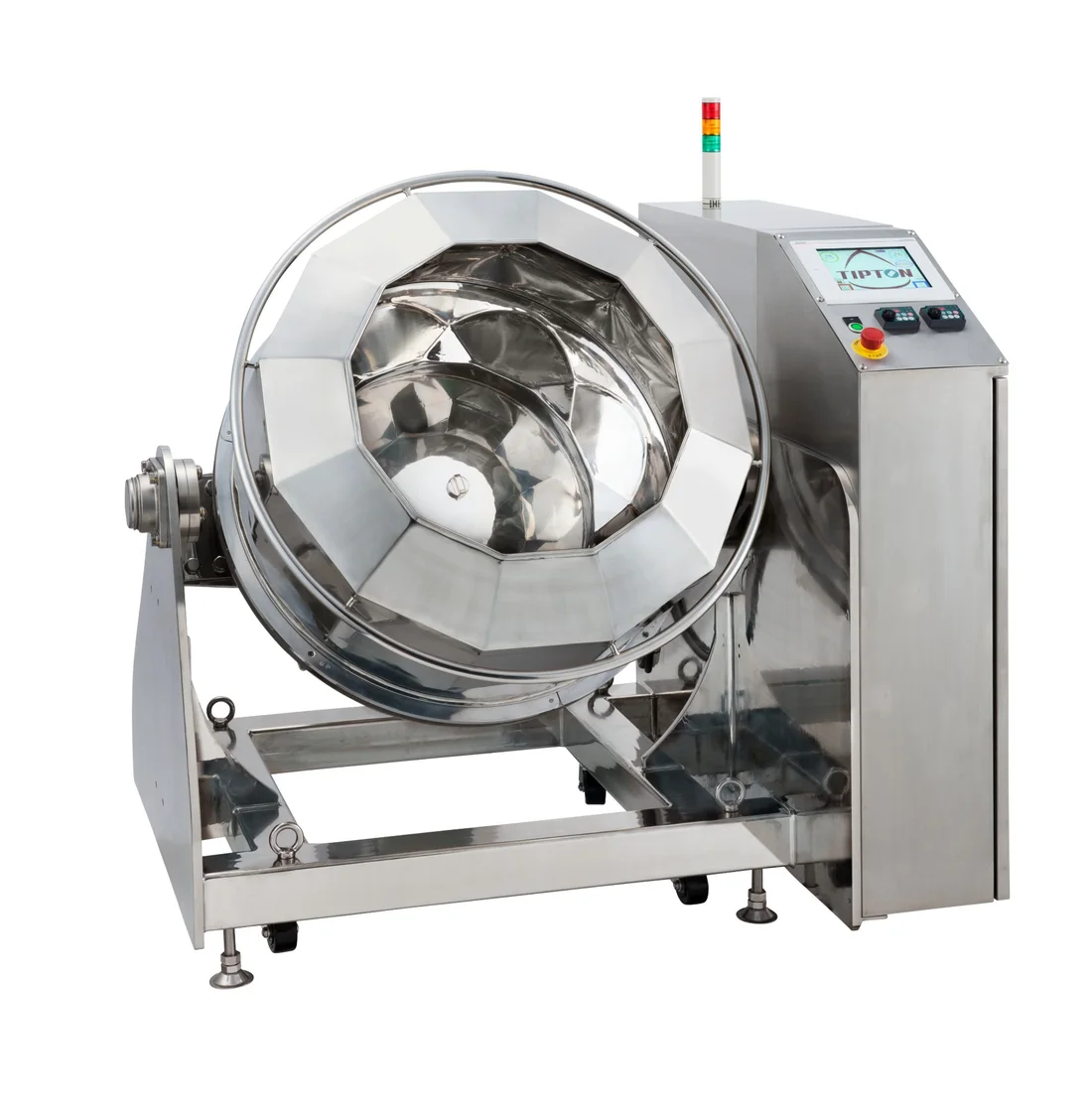
Tipton’s coating systems come from more than sixty years of work on how products move in a rotating vessel — first in barrel finishing, since 1993 in confectionery coating, and since 2013 in the ECX series.
See it in 3D
A two-dimensional drawing cannot fully show how the product moves inside an ECX. Tipton’s 3D animation shows the flow pattern from inside the vessel.
Simplified top view: drum and disc rotate in opposite directions; speeds are set separately.
The Multi-Spin principle
In a conventional coating pan, the movement of the product is largely fixed by the pan. In an ECX system the drum and the disc rotate in opposite directions, each driven separately, so the intensity of the movement can be set to the product.
That turns product movement into a process variable — alongside temperature, airflow, dosing and timing. For difficult products this matters: a fragile freeze-dried berry and a sticky gummy need very different movement, sometimes within the same process.
Inside an ECX system
The ECX series combines three elements described in Tipton’s public catalogue. Together they create a strong spiral vortex flow without a mixing blade.
Disc and drum are driven separately. Rotating in opposite directions, they increase agitation so that even fine and lightweight materials can be processed — and the speed of each can be set to the product.
A uniquely shaped disc made of polyhedral facets strengthens the spiral vortex flow. Pieces are pushed against the drum wall, where excess coating falls back into the mix. There is no mixing blade.
A continuous flow of air through the gap between disc and drum stops base powders and fine media from falling through.
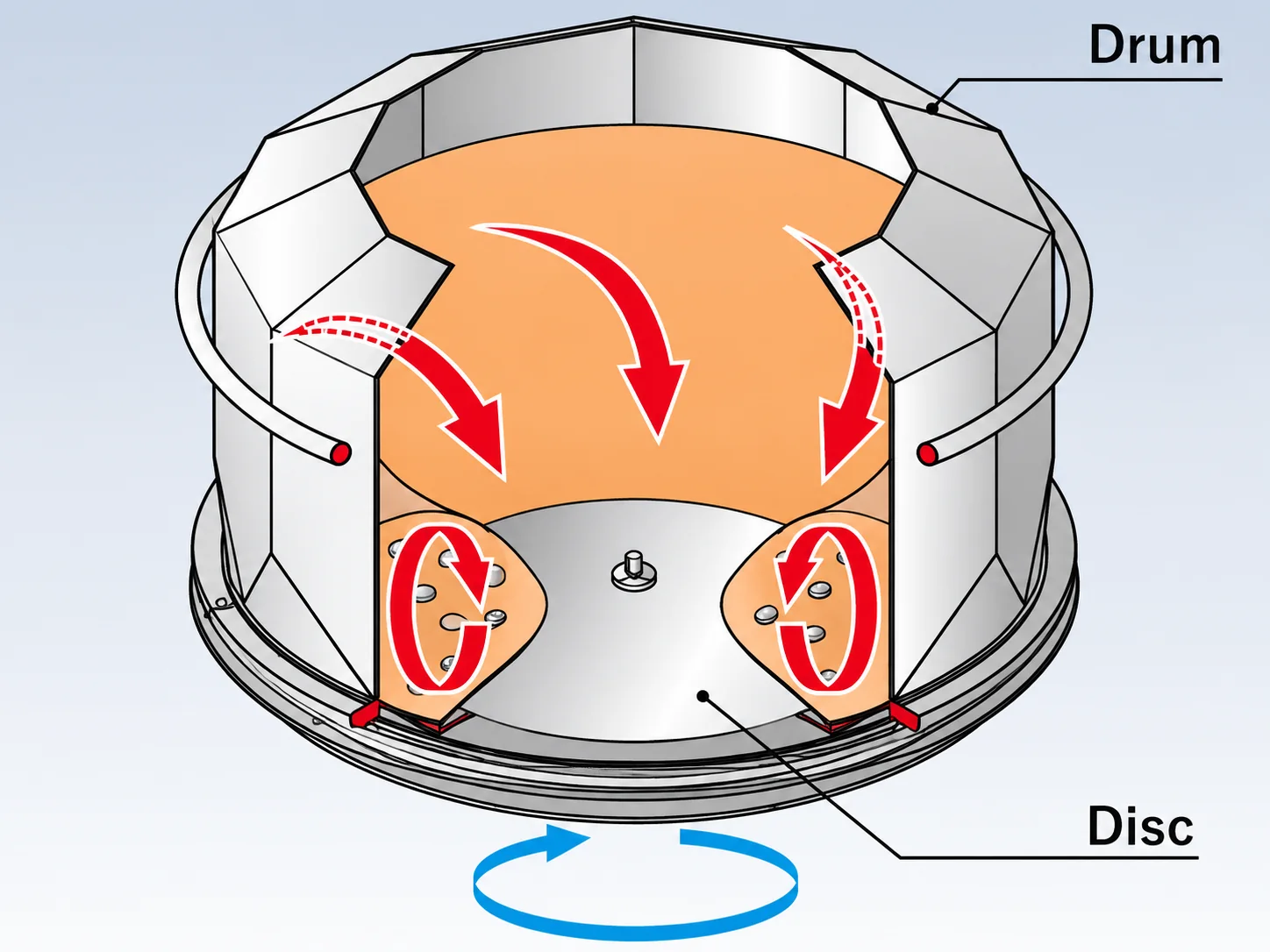
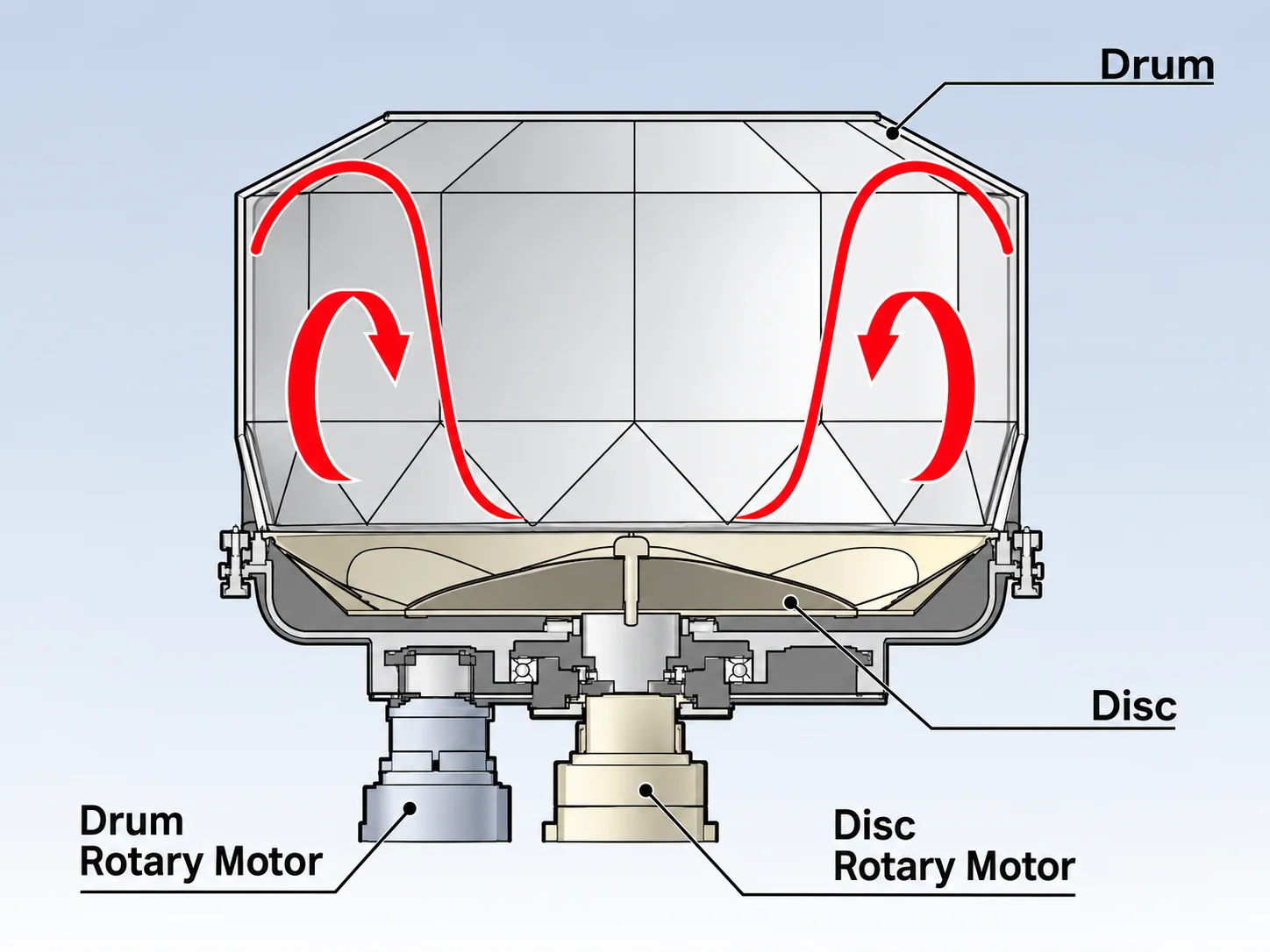
Diagrams: Tipton Corp.
Further ECX-related patents listed by Tipton: JP6062780, JP7586552, WO2023047529.
Processes
Tipton describes the ECX platform for granulation, coating, sizing and mixing. The open top and tilting discharge make it straightforward to load, empty, clean and connect to other process steps.
Chocolate, sugar (soft and hard), film and powder coatings — from confectionery to health food and pharmaceuticals.
Spherical granulation from fine raw materials, as shown in Tipton’s published examples.
Rounding and densifying particles through centrifugal force.
Gentle blending without a mixing blade.
Fragile, soft, moist, irregular and porous centres all react differently to movement. More ways to control that movement mean more options to test — not a guarantee. Whether those options help your product is exactly what a trial arranged with Tipton is for.
How a trial worksDid you know?
Engineering facts from Tipton’s public information — useful context, not performance promises.
Tipton developed its first confectionery coating machine (CCM).
Food coating equipment (ECM) followed.
The ECX coating system was developed.
Tipton developed centrifugal barrel finishing — the movement know-how behind ECX.
Patents held by Tipton (490 in Japan, 239 overseas), as of 20 September 2025.
Trial locations: Aachen, Germany (D&F Sweets, our European trial partner), Nagoya, Japan and Wixom (Detroit), USA.
Source: Tipton Corp., tipton.co.jp and ECX series catalogue.
Tell us what you want to make and what stands in the way. We review it, tell you honestly whether a trial with Tipton makes sense, and agree the next steps together.
Start a Project