Buyer's guide
Choosing a panning machine: pan, drum or multi-spin?
What to check before buying a chocolate or sugar panning machine: product, batch size, air, operator, cleaning, scale-up, and why you test first.
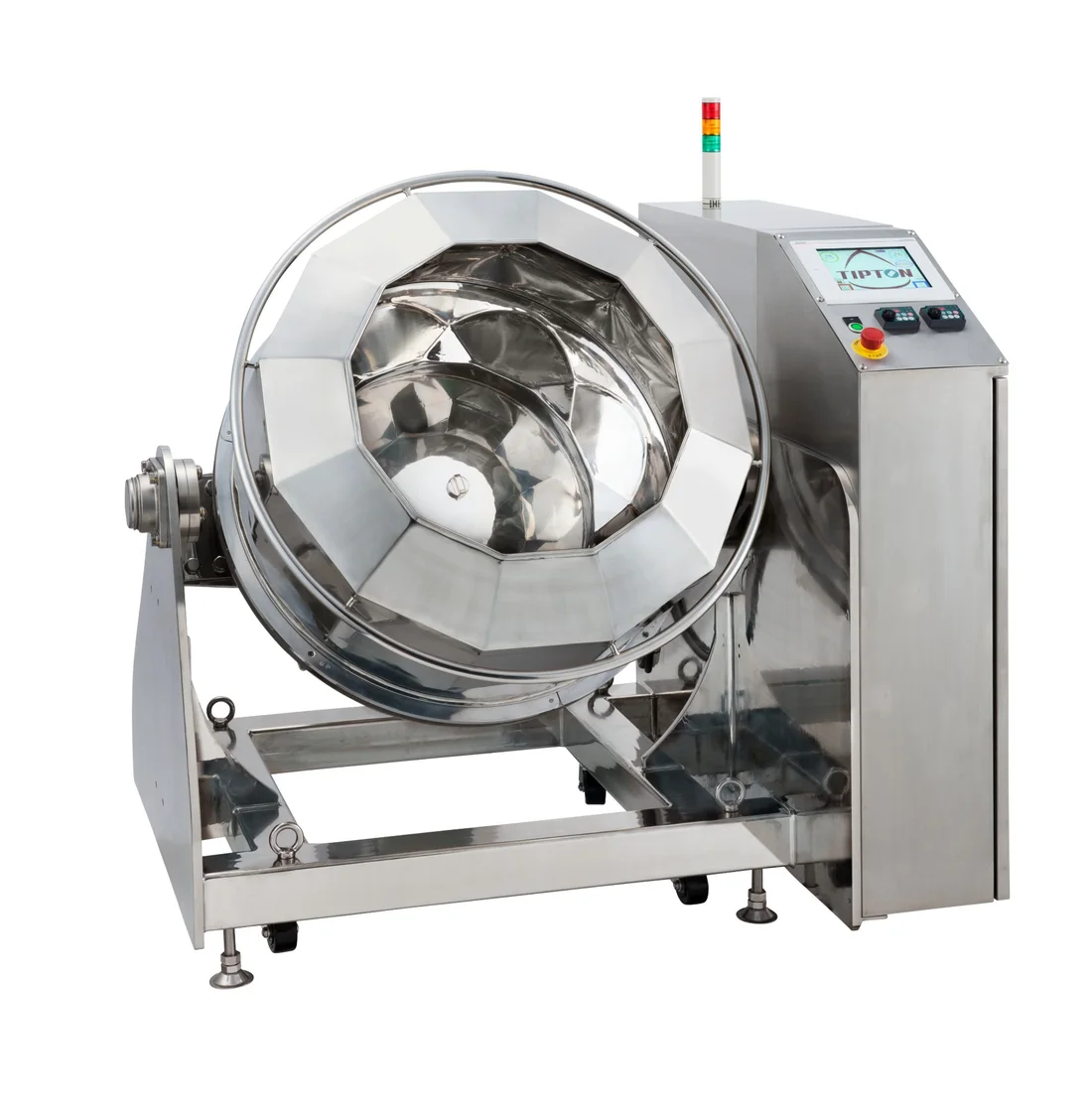
Search for “chocolate panning machine” and you will find hundreds of offers, from tabletop pans for a shop counter to fully automatic coating lines. Prices, photos and specification sheets look similar. What they rarely tell you is the one thing that decides whether the machine will work for you: how your product moves inside it.
This guide sets out the questions we ask with every manufacturer before a machine is even discussed.
Start with the product, not the machine
The same machine can be perfect for almonds and wrong for freeze-dried strawberries. Before comparing equipment, describe your product honestly:
- The centre: size, shape, weight, how round it is, how fragile it is, and whether it releases oil, dust or moisture.
- The coating: chocolate or compound, sugar syrup (hard or soft panning), a powder, a film or a polish, and how many layers you need.
- The finish: matte, shiny, sanded, coloured or printed.
- The batch: how much you need per batch and per shift today, and in two to three years.
Round, robust centres such as nuts and beans are forgiving. Flat, pointed or fragile centres are where machines really differ.
The three main machine types
| Type | How the product moves | Typical strengths | Typical limits |
|---|---|---|---|
| Classic coating pan | Open bowl on an inclined axis; pieces roll in a cascade at the bottom | Simple, flexible, low entry cost, easy to see and correct by hand | Result depends strongly on the operator; dead zones; doubles with flat pieces; long cycles for sugar shells |
| Coating drum | Closed, perforated or solid drum with controlled air in and out | Good air control, automation, suited to sugar and film coating | Larger footprint and investment; movement still driven by gravity and rotation alone |
| Multi-spin (TIPTON ECX) | Drum and disc rotate in opposite directions; a faceted disc and an air gap create a three-dimensional vortex | Fast, even mixing; repeatable settings; automatic discharge | Newer technology in Europe; best judged in a trial with your own product |
In a pan or drum, gravity and rotation do all the work: pieces are lifted, roll down and mix in the cascade. In the ECX, the disc at the bottom turns against the drum, so the whole batch is in motion all the time. According to Tipton Corp., the batch is completely mixed in about five seconds, which is why the coating spreads evenly instead of collecting on the pieces at the surface.
Seven questions to ask every supplier
1. How evenly does the coating spread?
Uneven distribution means some pieces get too much coating and others too little, so you need more layers to bring the thinnest pieces up to specification. Ask to see cross-sections of coated pieces from the same batch, not only the best sample.
2. How much depends on the operator?
In a classic pan, an experienced operator adjusts dosing, timing, air and speed by eye and by feel. That skill is valuable and scarce. Ask which settings are stored in the machine and how a new operator reaches the same result on the second day.
3. How is air handled?
Chocolate needs cool, dry air to set; sugar layers need warm, dry air to dry. Humidity matters as much as temperature: Callebaut, for example, advises relative humidity below 60 % for a good shine on panned chocolate. Check the air supply, the exhaust, and whether you will need extra air conditioning in the room.
4. How long is a cycle, and how much material is lost?
Cycle time decides your capacity; material loss decides your margin. According to Tipton Corp., multi-spin coating on ECX runs two to three times faster than a conventional pan, and material loss is below about 2 % compared with about 5 % in a conventional pan. Ask every supplier for comparable figures, and ask how they were measured.
5. How do you discharge, clean and change product?
Count the minutes between two products: emptying, cleaning, drying and setting up. With allergens or several colours in one shift, changeover time can matter more than coating time. The ECX tilts to discharge the batch automatically.
6. How will you scale up?
A recipe that works in a 40-litre development pan does not automatically work in a full-size production pan, because the motion changes with size. Ask whether the supplier offers a small and a large machine with the same movement principle. TIPTON ECX comes as the ECX40 (40 L drum, 5–15 L processing volume) for development and small series, and the ECX200 (200 L drum, 50–70 L) for production.
7. Who supports you after delivery?
Ask about installation, training, spare parts and response times in your country, and whether the machine carries the CE marking for the EU.
New or used?
A used coating pan can be a good way to start with a simple product. Check:
- the CE marking and documentation;
- the condition of the bowl or drum surface;
- the drive and the air system;
- whether spare parts are still available.
The real risk is not the machine’s age but the fit. A low-priced machine that cannot coat your centre evenly is not cheap.
Test before you decide
Specification sheets cannot show how your centre behaves. The only reliable answer is a trial with your own centres and your own coating material, with the results you will measure in production:
- coverage;
- breakage;
- doubles;
- cycle time;
- finish.
We arrange trials on TIPTON ECX at our European trial partner D&F Sweets in Aachen, Germany, and, for larger projects, with Tipton Corp. in Japan. We will also tell you honestly if ECX is not the right route for your product.
Questions
Frequently asked.
What is the difference between a coating pan and a coating drum?
A classic coating pan is an open bowl that turns on an inclined axis; the pieces roll in a cascade at the bottom. A coating drum is usually a closed, horizontal or slightly inclined cylinder with air ducts, often used for sugar and film coating. Both rely on gravity and rotation to move the pieces. A multi-spin system such as TIPTON ECX adds a second movement: a disc at the bottom that turns in the opposite direction to the drum.
Should I buy a used coating pan?
A used pan can be a sensible start for simple products. Check the CE marking and documentation, the condition of the bowl surface, the drive and the air system, the availability of spare parts and how it will be cleaned. Most importantly, check that the machine suits your product: a cheap machine that cannot coat your centre evenly is not cheap.
How large should my first machine be?
Size the machine for the batches you will really run in the next two to three years, not for the peak you hope for. Many manufacturers start with a smaller system for development and small series and add a production machine with the same movement principle once the product is established, so the process does not have to be reinvented.
Can I test a machine before buying it?
Yes, and you should. A trial with your own centres and coating material is the only reliable way to see coverage, breakage, cycle time and finish. Tiptoncoating arranges trials on TIPTON ECX at D&F Sweets in Aachen, Germany, and, for larger projects, with Tipton Corp. in Japan.
NoteGeneral information, not a recipe or a guarantee. Coating results depend on your raw materials, formulation and factory conditions; only a trial with your own product shows what is possible.
Knowledge
Keep reading.
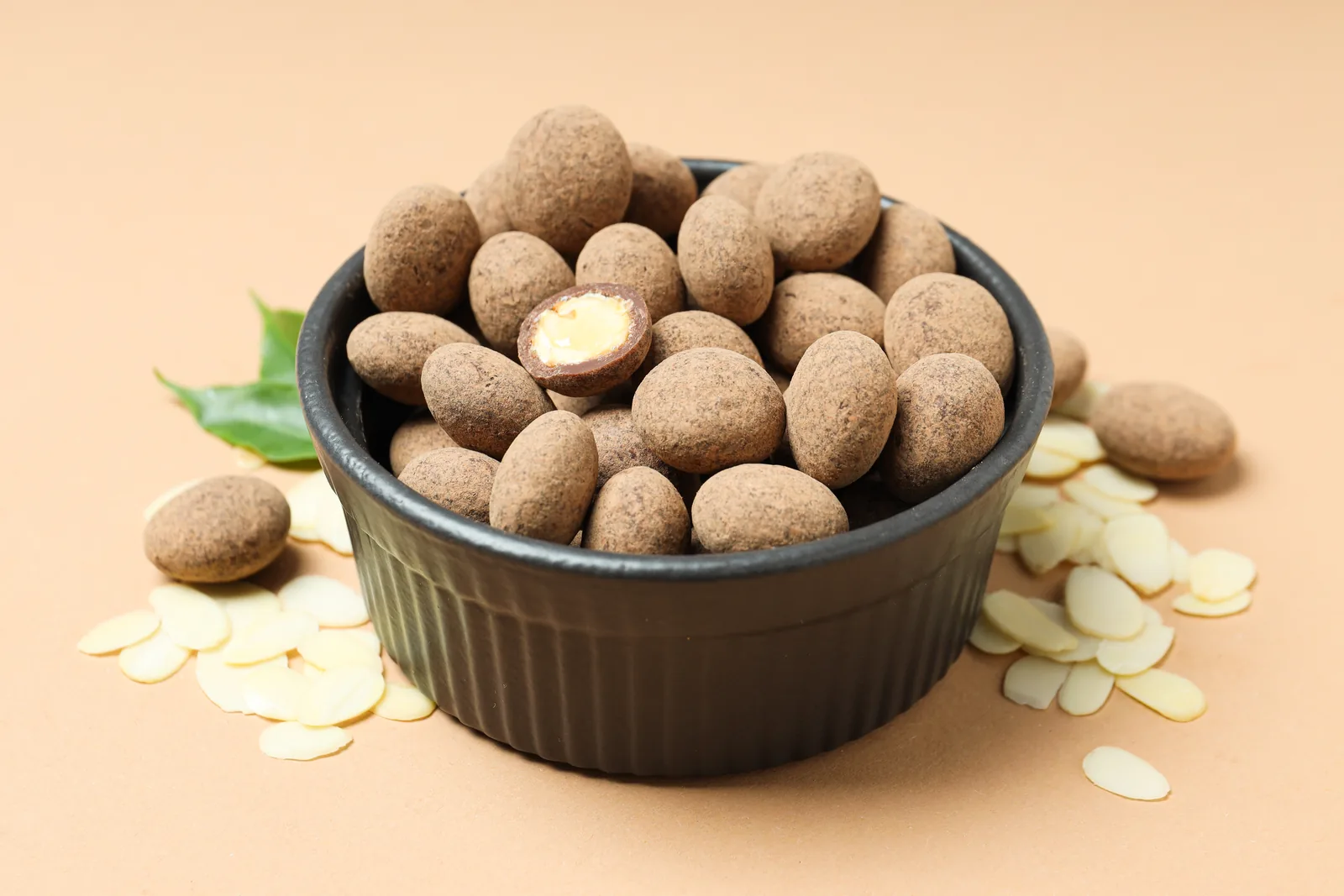
How a coating pan works, and where it reaches its limits.
How a classic coating pan works: rotation, cascade, angle, fill level, baffles and air, and why doubles, dead zones and long cycles follow.
Read · 7 min
Freeze-dried fruit in chocolate: why it is hard at scale.
Chocolate-coated freeze-dried strawberries are everywhere in retail. Why they are hard to produce at scale, and how to plan a trial.
Read · 7 minShow us the product that is difficult today.
Tell us what you want to make and what stands in the way. We review it, tell you honestly whether a trial with Tipton makes sense, and agree the next steps together.
Start a Project