Technology
How a coating pan works, and where it reaches its limits.
How a classic coating pan works: rotation, cascade, angle, fill level, baffles and air, and why doubles, dead zones and long cycles follow.
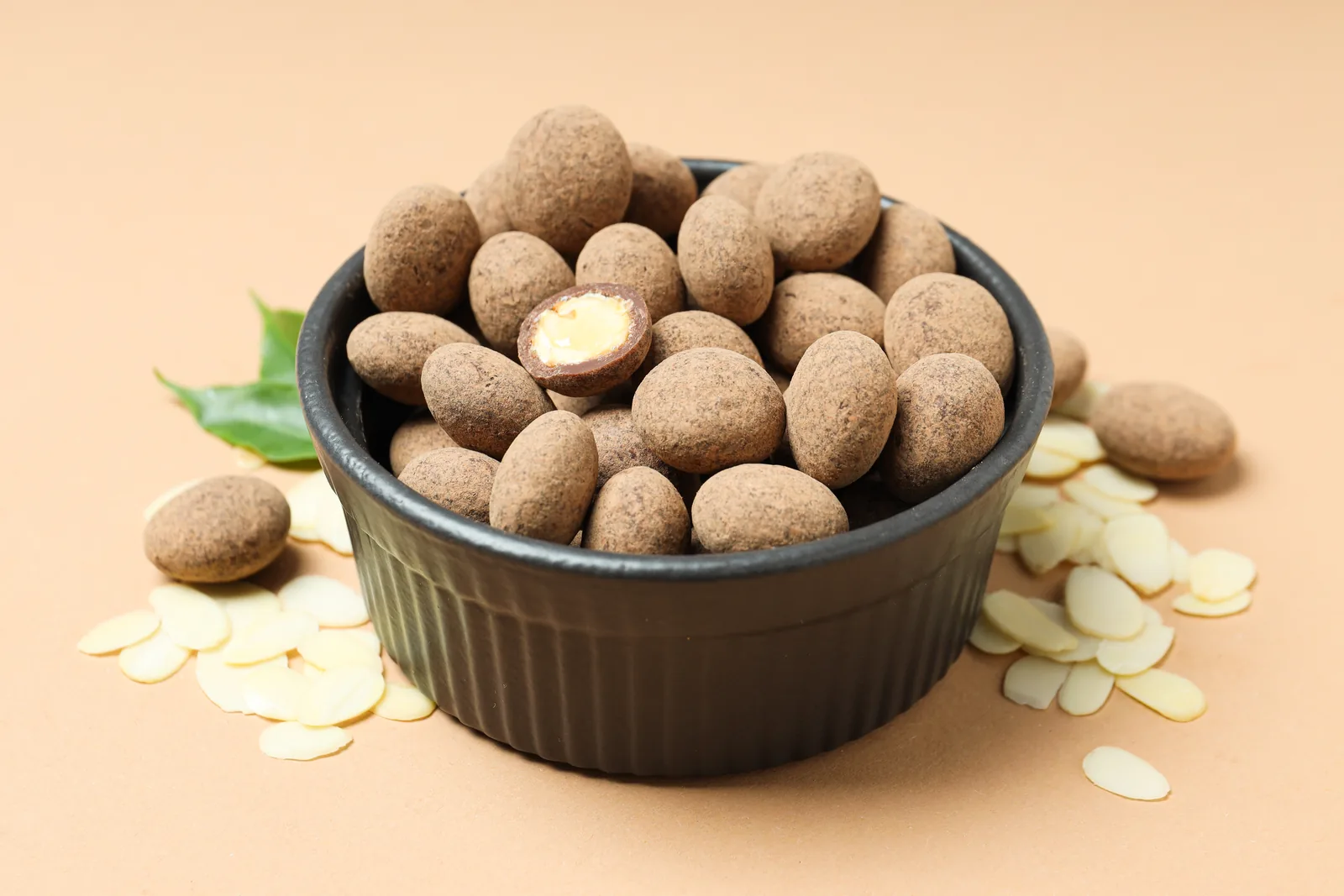
The coating pan is one of the oldest machines in confectionery, and still one of the most common. Dragées, chocolate-coated nuts, sugar-shelled sweets and many tablets have been made in rotating bowls for generations. To use a pan well, and to know when another principle makes sense, it helps to understand what actually happens inside.
The principle: rotation, lift and cascade
A coating pan is a bowl that turns on an inclined axis. As it rotates, friction carries the pieces up the wall until gravity pulls them back down. They roll and tumble over each other in a cascade at the lower front of the bowl.
The coating is added in small portions, as melted chocolate, sugar syrup or powder. The cascade spreads it from piece to piece. Air then sets or dries the layer, and the next portion follows. Hundreds of thin layers build up the final shell.
The quality of the result depends on how well that cascade mixes. Everything an operator adjusts serves that one goal:
- Speed: too slow and the pieces slide as a block; too fast and they are thrown around or pressed against the wall.
- Angle: a steeper axis holds more product but changes how the bed rolls.
- Fill level: too little product and the pieces slide; too much and the middle of the bed barely moves.
- Baffles or ribs: lift the pieces higher for better mixing, at the cost of more impact on fragile centres.
- Air: cool, dry air sets chocolate; warm, dry air dries sugar layers. Its temperature, humidity and how it reaches the bed decide how fast each layer can follow.
Why results depend on the operator
None of these settings stays constant through a batch. The pieces grow with every layer, the bed changes its behaviour, and the room’s temperature and humidity change through the day.
An experienced panner reads the cascade and corrects by eye and by hand: a little less syrup, a pause for drying, a change in air. This is why panning is often called an art as much as a science. It is also why the same pan can give different results with two different operators.
Where a classic pan reaches its limits
The limits of a pan come from the same physics that makes it work.
Dead zones
The cascade moves the surface of the bed well, but pieces in the core and near the wall move less. Coating lands first on the pieces that are on top, so distribution evens out only over time and many rotations. That is one reason more layers are often needed to bring the thinnest pieces up to specification.
Doubles and clusters
Pieces stuck together form when they touch while the coating is wet and stay together as it sets. Flat or irregular centres, too much coating per charge, slow mixing and a cold room all make doubles more likely. Breaking them apart costs time and leaves visible marks.
Long cycles
Each layer has to spread and set before the next one goes on. With slow mixing, the operator has to wait longer. Hard sugar shells in particular can take many hours. According to Tipton Corp., a hard coating that takes about 16 hours in a conventional pan was completed in about 5.5 hours on a multi-spin ECX system.
Fragile and irregular products
Soft, porous or flat centres suffer in the cascade: they break, chip or stack. These products are often the most interesting commercially, and the hardest to make in a pan.
Scale-up
A larger pan is not just a bigger version of a small one. The height of the fall, the pressure in the bed and the airflow all change with size. A process that works in a development pan often has to be found again on the production machine.
A different way to move the product
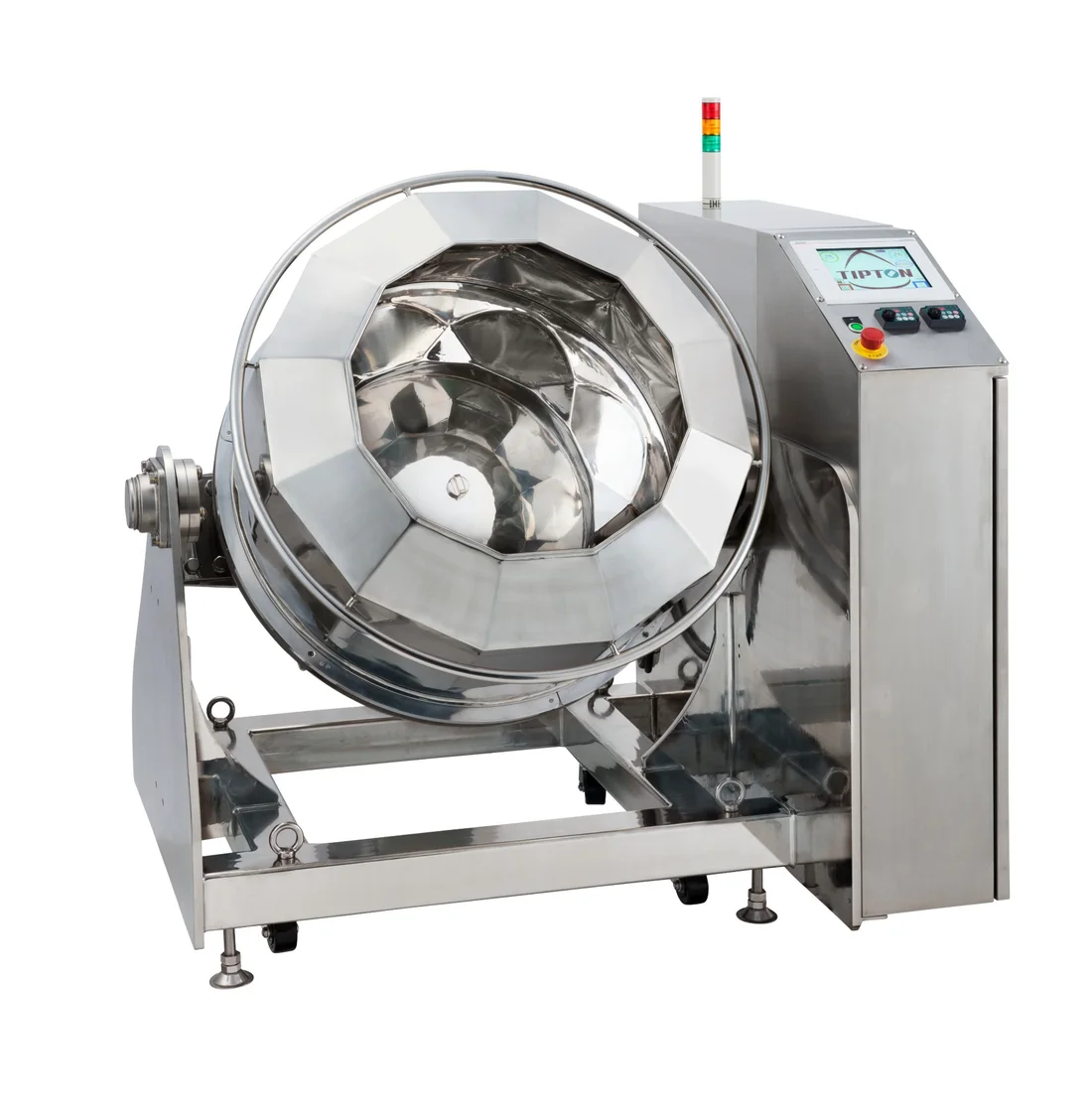
TIPTON ECX takes a different approach to the same task:
- Two movements: the drum and a disc at its base rotate in opposite directions.
- A three-dimensional vortex: a faceted disc and a narrow air gap move the product through the whole volume, not only in a cascade at the surface.
- Fast mixing: according to Tipton Corp., the batch is completely mixed in about five seconds, so each dose of coating spreads over the whole batch almost at once.
This makes the product movement itself a setting that can be stored and repeated, instead of a feel the operator has to rebuild every time. Tipton offers the ECX40 for development and small series and the ECX200 for production, with the same principle in both.
Pan or multi-spin?
A classic pan remains a good tool for many robust, round products and for small workshops. A different movement principle becomes interesting when:
- the result depends too much on one person;
- doubles, breakage or uneven layers cost you material and time;
- cycles limit your capacity;
- you want to develop products a pan cannot make reliably.
Whether that is true for your product can only be shown in a trial with your own centres and coating.
Questions
Frequently asked.
Why do coating pans produce doubles?
Doubles form when two pieces touch while the coating is still wet and stay together as it sets. Flat or irregular centres, too much coating per charge, slow mixing and a cold room all make it more likely, because pieces spend more time pressed against each other before the layer is spread and set.
What do baffles in a coating pan do?
Baffles or ribs on the inside of the pan lift the pieces higher before they fall back, which improves mixing and reduces sliding. They also add contact and impact, so fragile centres can break more easily, and they create corners that need extra cleaning.
What is the right fill level for a coating pan?
There is no single figure: it depends on the pan size, the angle and the product. Too little product and the pieces slide instead of rolling; too much and the bed in the middle hardly moves. Manufacturers' recommendations and a few test batches with your own centres give the working range.
Is a multi-spin machine just a faster pan?
No. In a pan the batch is moved only by the rotation of one vessel and by gravity. In TIPTON ECX the drum and a disc at the bottom rotate in opposite directions, and a faceted disc and an air gap create a three-dimensional vortex, so the product movement itself becomes a process setting.
NoteGeneral information, not a recipe or a guarantee. Coating results depend on your raw materials, formulation and factory conditions; only a trial with your own product shows what is possible.
Knowledge
Keep reading.
Choosing a panning machine: pan, drum or multi-spin?
What to check before buying a chocolate or sugar panning machine: product, batch size, air, operator, cleaning, scale-up, and why you test first.
Read · 8 min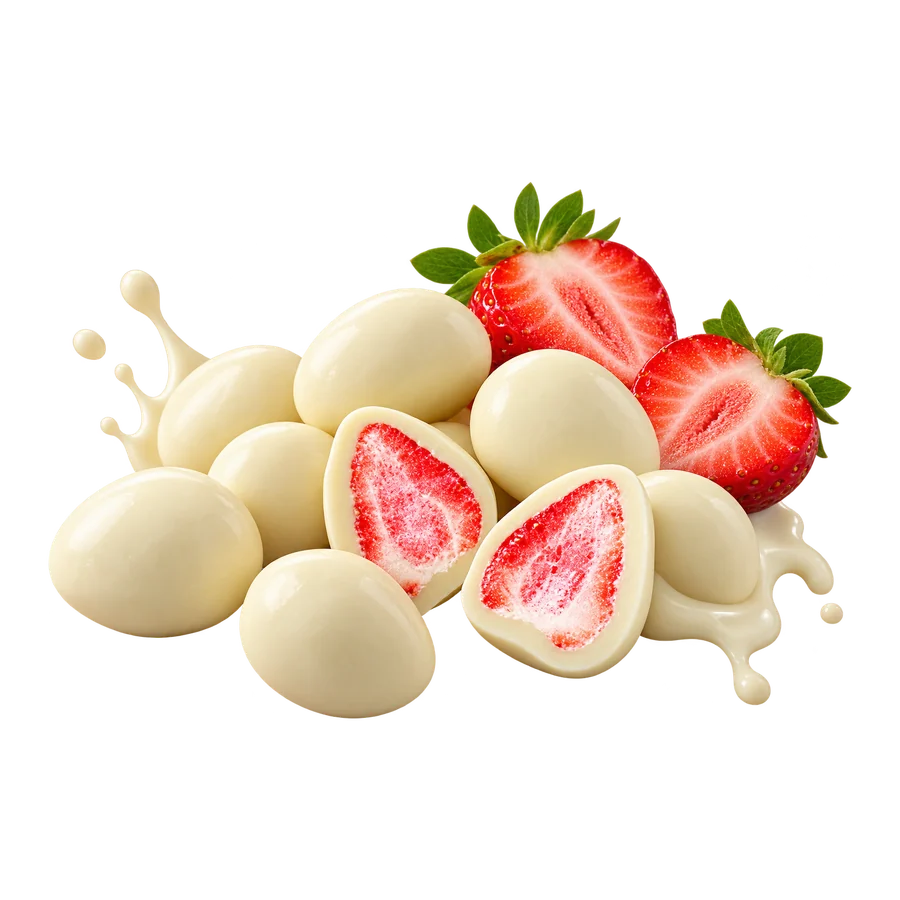
Freeze-dried fruit in chocolate: why it is hard at scale.
Chocolate-coated freeze-dried strawberries are everywhere in retail. Why they are hard to produce at scale, and how to plan a trial.
Read · 7 minShow us the product that is difficult today.
Tell us what you want to make and what stands in the way. We review it, tell you honestly whether a trial with Tipton makes sense, and agree the next steps together.
Start a Project