Specialty application
Freeze-dried fruit in chocolate: why it is hard at scale.
Chocolate-coated freeze-dried strawberries are everywhere in retail. Why they are hard to produce at scale, and how to plan a trial.
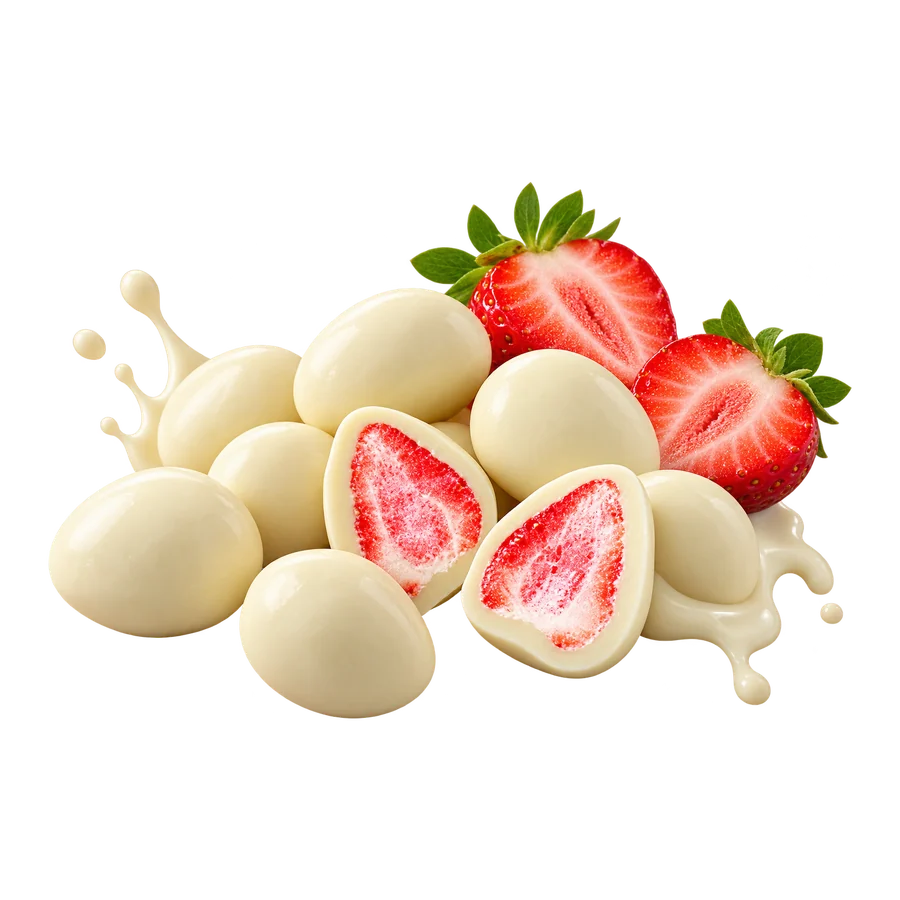
Freeze-dried strawberries in white or milk chocolate have moved from specialty shops to the shelves of drugstores and discount chains across Europe. Raspberries, mango, banana and sour cherries are following. For manufacturers the attraction is clear: an intense fruit taste, a crisp texture and a “real fruit” story.
Making them consistently, in volume, is another matter. Here is why, and how to approach it.
What makes freeze-dried fruit different
Freeze-drying removes almost all water from the fruit while keeping its shape. What is left is a light, porous structure, which is exactly what makes it difficult to coat.
1. It is fragile
A freeze-dried strawberry has very little mechanical strength. In a tumbling bed it collides with other pieces and with the vessel wall, again and again, until enough chocolate has built up to protect it. Pieces break, edges chip, and the bed fills with crumbs.
2. It creates dust
Broken fruit and fine powder from the surface mix into the chocolate. This dulls the colour, makes the surface rough and can spoil the finish of a whole batch.
3. It attracts moisture
Freeze-dried fruit is extremely dry and draws moisture from the air. Moisture softens the crisp texture and can lead to sugar bloom on the chocolate surface. Chocolate also does not adhere well to a damp surface. Room humidity matters during coating, and packaging matters afterwards.
4. It is porous
The open structure can absorb fat from the coating and needs more material before a closed, smooth layer forms.
5. Its shape is irregular
Halves, slices and whole berries come in many shapes. Flat sides lie against each other and form doubles; points and edges are hard to cover evenly. Industry literature notes that pointed products in particular are difficult to cover in a pan.
How manufacturers usually approach it
There is no single recipe, and we do not provide one. These are the questions a development team typically works through:
- Raw material: fruit variety, piece size and how much breakage and dust arrive in the bag.
- Sealing the surface: many processes start with a thin first layer to close the surface and stabilise the piece before the main coating builds up. Dried fruit is often prepared to stop pieces sticking together, as Puratos shows with dextrose in a panned fruit example.
- Gentle build-up: small charges and well-timed cooling, so each layer sets before the next one, without holding the pieces too long in a moving bed.
- Climate: a cool, dry room. Callebaut, for example, advises relative humidity below 60 % for a good shine on panned chocolate.
- Finish and protection: polishing and glazing to protect the shine.
- Packaging: a moisture barrier that keeps the fruit crisp through its shelf life.
Where the machine comes in
In a classic pan or drum, the batch is moved by rotation and gravity alone. Pieces are lifted and fall back in a cascade. That works well for robust centres such as nuts. For fragile fruit, the same impacts that mix the batch are what break it.
TIPTON ECX moves the batch in a different way: the drum and a disc at the base rotate in opposite directions, and the whole batch is in motion at once. According to Tipton Corp., it is completely mixed in about five seconds, so each portion of coating spreads quickly over all pieces.
For fragile products, that changes the questions a trial has to answer:
- How much breakage does your fruit show?
- How quickly does a protective first layer close?
- How smooth is the finish?
We treat freeze-dried fruit as a specialty application, assessed in a trial. We cannot promise in advance that it works for every fruit, size and coating.
Planning a trial
A useful trial for freeze-dried fruit compares a few things with your current method:
- Breakage and dust: the share of broken pieces after coating.
- Doubles: the share of pieces stuck together.
- Coverage: whether the fruit is fully closed, including points and edges.
- Coating ratio: fruit to chocolate, and the spread between pieces.
- Texture: crispness after a defined storage period.
- Cycle time: from loading to discharge.
Bring your own fruit and coating material, so the results reflect your raw materials, not ours. We arrange trials on TIPTON ECX at D&F Sweets in Aachen, Germany. The recipe and the end product remain your own.
Questions
Frequently asked.
Can freeze-dried strawberries be coated in a normal coating pan?
Small quantities often can, with care. At production scale the main problems are breakage in the tumbling bed, crumbs and fruit dust in the chocolate, moisture pick-up and doubles with irregular pieces. Whether a given fruit and process work together can only be shown in a trial with your own raw material.
Why does freeze-dried fruit go soft after coating?
Freeze-dried fruit is extremely dry and draws moisture from the air and from anything around it. If it takes up moisture before or during coating, or if the packaging does not protect it, the crisp texture is lost. Room humidity, the moisture content of the coating and the barrier properties of the packaging all play a part.
Is freeze-dried fruit a standard application for TIPTON ECX?
No. We treat soft and fragile products such as freeze-dried fruit as a specialty application. ECX moves the product differently from a pan, but whether that suits a particular fruit, size and coating is decided in a trial, not promised in advance.
Do you provide a recipe for chocolate-coated freeze-dried fruit?
No. Neither Tiptoncoating nor Tipton Corp. provides recipes or promises a particular end product. We arrange trials, machine evaluation and operator training; the recipe and the responsibility for production remain with the manufacturer.
NoteGeneral information, not a recipe or a guarantee. Coating results depend on your raw materials, formulation and factory conditions; only a trial with your own product shows what is possible.
Sources
- Panning (food) – Wikipedia
- Tutti frutti panning recipe (dried fruit, anti-sticking) – Puratos
- Ruby raspberries treasure (panning recipe notes on humidity) – Callebaut
- Chocolate bloom – Callebaut
- Panning and coating (chapter), Industrial Chocolate Manufacture and Use – Springer
- Troubleshooting chocolate problems – New Food Magazine
Knowledge
Keep reading.
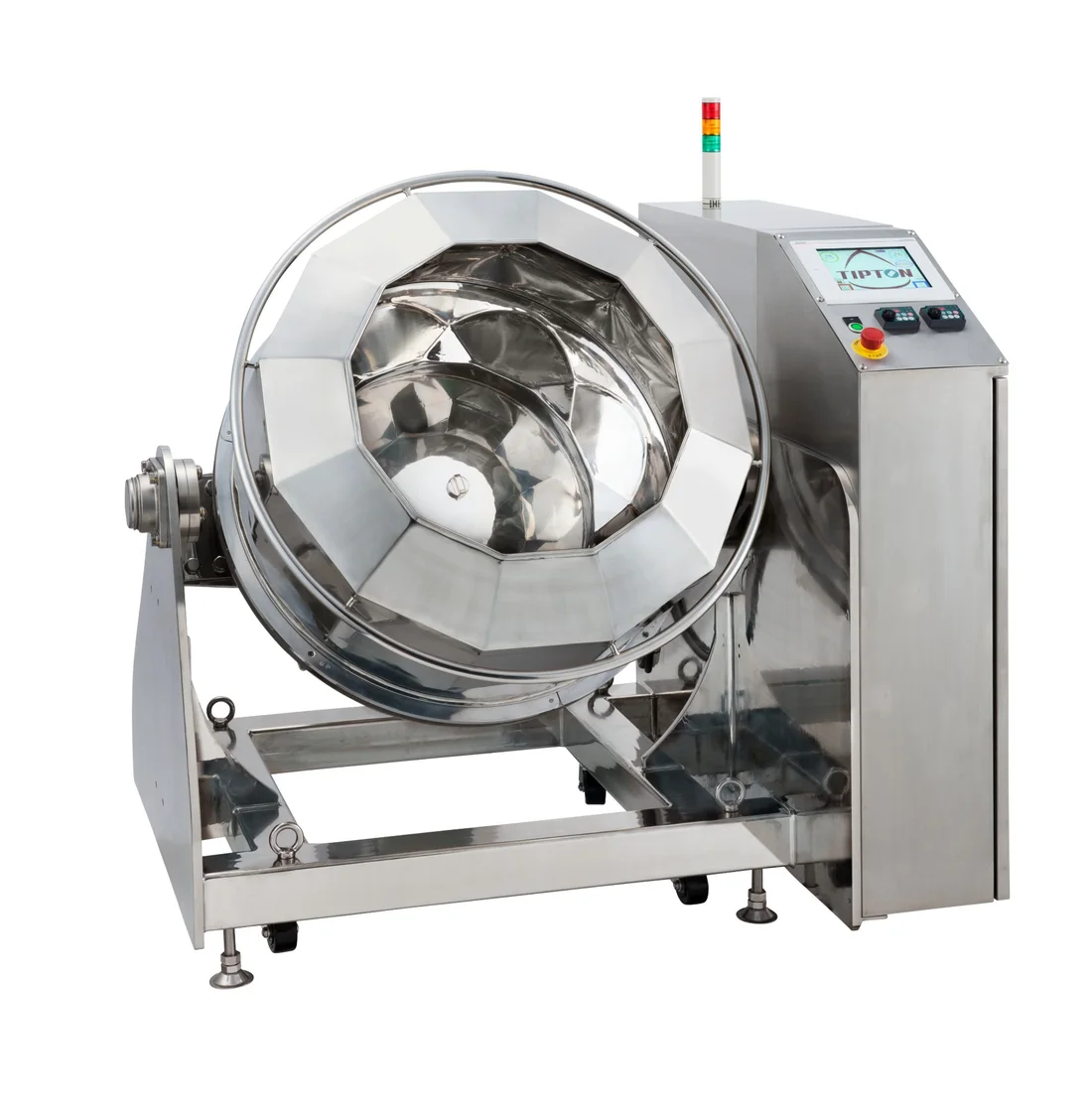
Choosing a panning machine: pan, drum or multi-spin?
What to check before buying a chocolate or sugar panning machine: product, batch size, air, operator, cleaning, scale-up, and why you test first.
Read · 8 min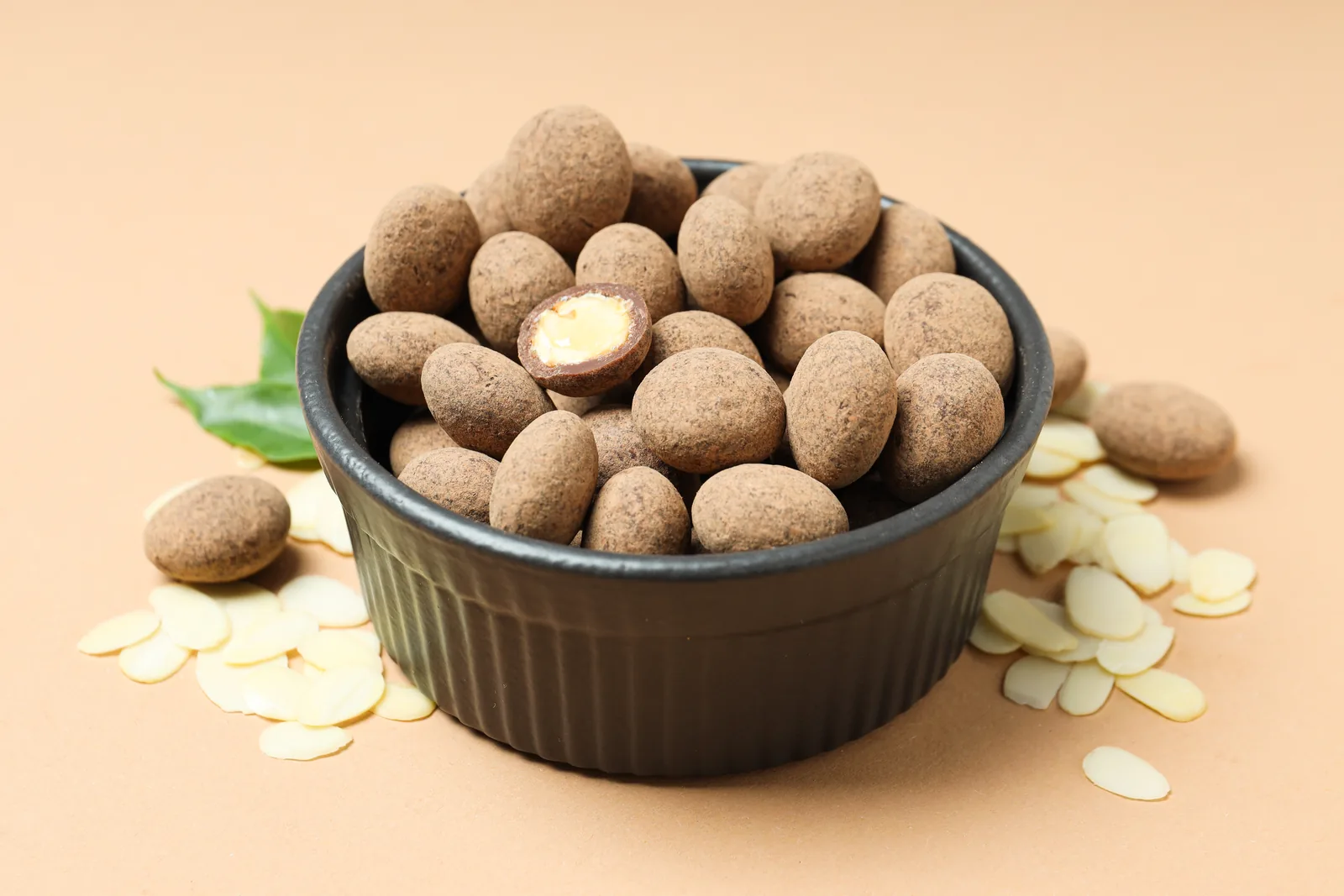
How a coating pan works, and where it reaches its limits.
How a classic coating pan works: rotation, cascade, angle, fill level, baffles and air, and why doubles, dead zones and long cycles follow.
Read · 7 minShow us the product that is difficult today.
Tell us what you want to make and what stands in the way. We review it, tell you honestly whether a trial with Tipton makes sense, and agree the next steps together.
Start a Project